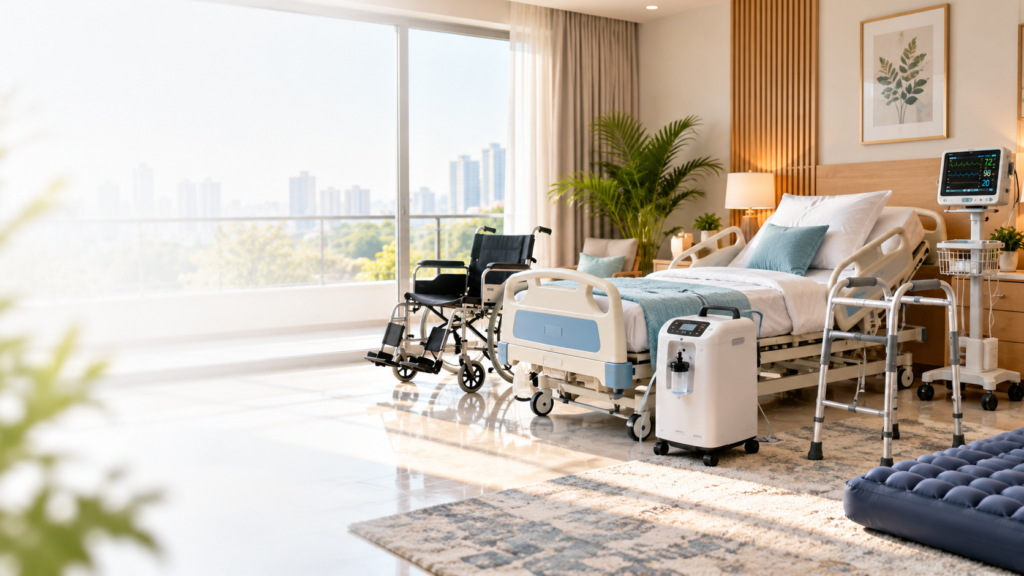
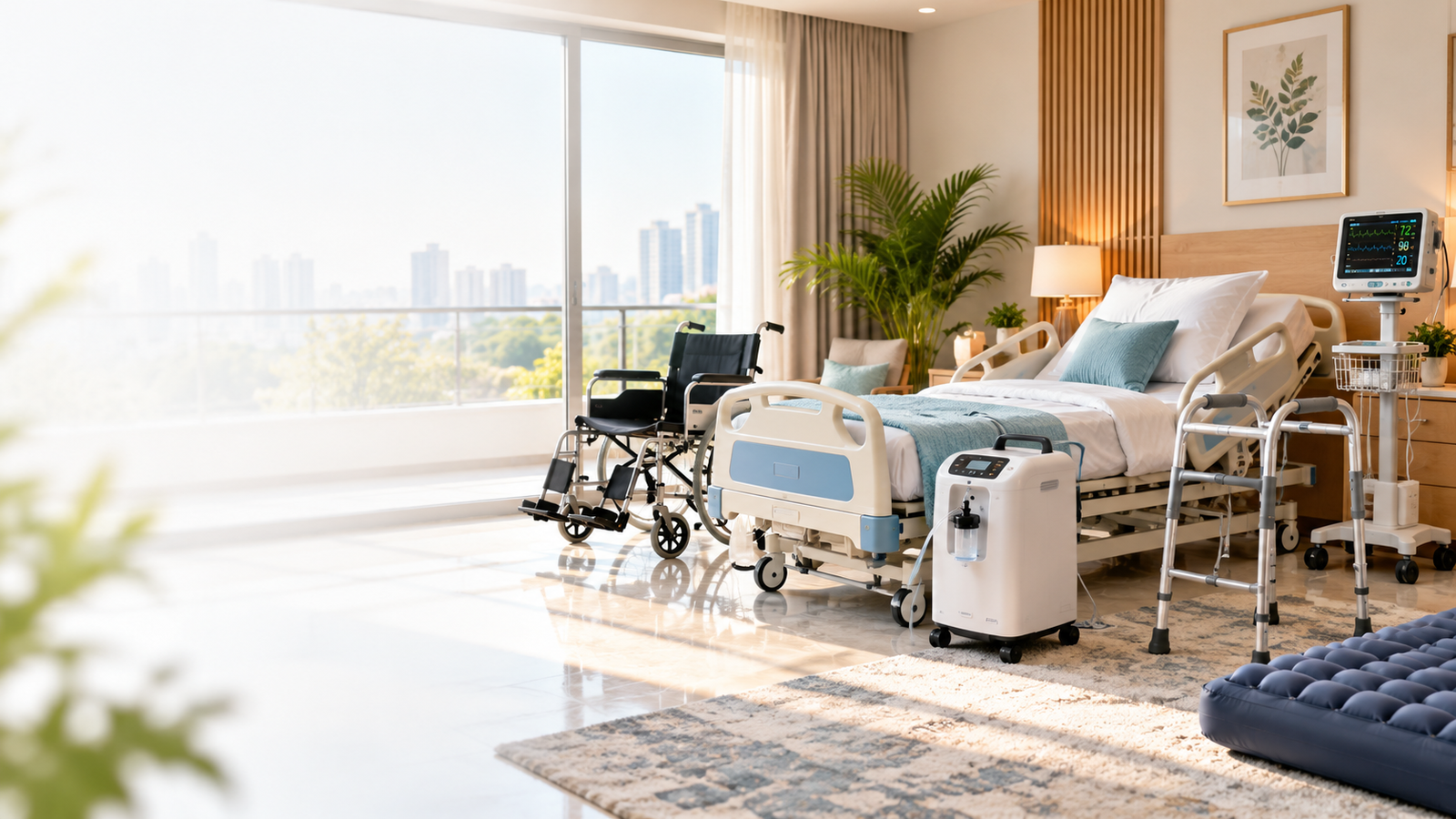

Medical equipment for home recovery in Gurugram. Illustration is representative; equipment selection must follow the treating medical team's plan.
Hospital Discharge Checklist 2026: Essential Medical Equipment for Home Care in Gurgaon
Coming home from hospital? Use this practical, doctor-first checklist to prepare your room, select essential patient-care equipment, compare rent-versus-buy options, and arrange a safer transition in Gurgaon.
Preparing for Hospital Discharge: Start With the Patient, Not the Equipment
Hospital discharge can be a relief for patients and families, but the move from a clinical setting to a home environment also introduces new responsibilities. The bed might be too low, the bathroom may be difficult to reach, the patient may need support to stand, or a prescribed medical device may require a suitable electrical connection and a trained caregiver. Planning these practical details before the journey home can help reduce avoidable confusion.
When searching for medical equipment on rent in Gurgaon, the first step is to ask the discharge team for a written home-care plan. It should clarify what equipment is necessary, which professional will supervise its use, how medicines and follow-up visits will be managed, which symptoms require urgent attention, and whether any clinical measurements need recording. A comprehensive plan matters more than renting the largest number of devices.
Gurgaon Medical Equipment, based in Sector 47 near Subhash Chowk, lists hospital beds, oxygen concentrators, wheelchairs, walkers, patient monitors, suction machines, BiPAP devices, ICU equipment and other home-care products for rental or sale. This guide explains how families can evaluate those categories without assuming that every patient needs every item.
Who May Need Medical Equipment at Home After Discharge?
A person recovering from orthopaedic surgery may primarily need mobility support, a raised or adjustable bed, and bathroom aids. Someone with limited mobility after a stroke may require a wheelchair, safe transfer support and specialist skin-care planning. A person receiving prescribed home respiratory therapy may need a specific oxygen or breathing-support device, with clear instructions from the medical team. These examples illustrate how requirements differ; they are not a substitute for an individual assessment.
Home equipment can also be relevant for elderly patients, people recovering from prolonged hospital stays, those receiving selected palliative care at home, or patients whose complex needs are being supported by a coordinated community clinical team. It is important to distinguish basic recovery equipment from advanced critical-care equipment: a wheelchair or commode chair is not the same type of decision as a ventilator or infusion pump.
Ask the healthcare team to assess mobility, fall risk, skin condition, breathing support, medication administration and the skills of available caregivers. The plan should include what to do if the patient cannot safely transfer, if a device fails, or if symptoms worsen.
12 Essential Medical Equipment Categories to Discuss for Home Care in Gurgaon
The following categories help families organise a discussion with their doctor and equipment supplier. Select only the products that match the prescribed care plan and the home environment. Each link opens the related Gurgaon Medical Equipment product or service page.
Adjustable Hospital Bed
Many patients returning home after surgery or prolonged illness benefit from a bed that allows safe, practical positioning and easier caregiver access. Compare manual, three-function and five-function options by the adjustments recommended, patient weight, doorway width and room space. Ask the installer to demonstrate wheel brakes, side rails and safe transfer height.
Explore hospital bedsPressure-Redistributing Air Mattress
A suitable pressure-redistributing surface may be recommended for a person with limited mobility or elevated pressure-injury risk. Mattress types differ in comfort, airflow, noise, power needs and clinical suitability. A mattress is only one part of prevention: the healthcare team should also provide a skin-check and repositioning plan.
View air mattressesWheelchair for Safe Movement
A wheelchair may help someone with restricted walking ability move between rooms, attend follow-up visits or travel home from hospital. Check seat width, weight capacity, armrest and footrest design, brakes and the availability of an attendant. Measure lifts, doors and bathroom routes before delivery.
View wheelchairsWalker or Walking Aid
A walker can offer support for selected patients who have been assessed as safe to stand and walk. The correct height, grip and frame type matter; a poorly fitted walker may create rather than reduce hazards. Request a physiotherapist-approved aid and practise turning and transfers under supervision.
Explore walkersCommode Chair
For patients who cannot comfortably reach the bathroom, a commode chair may reduce the distance needed for toileting. Look at height, maximum load, stable feet, non-slip surfaces and ease of cleaning. Families should also plan privacy, lighting and a safe caregiver-assisted transfer process.
View commode chairsOxygen Concentrator
Some patients leave hospital with a documented home-oxygen prescription. In that case, the treating clinician should specify the device, delivery interface and prescribed flow; families should never select a flow rate using online advice. Discuss power backup, alarm response, safe ventilation and an emergency escalation plan before equipment arrives.
Explore oxygen concentratorsOxygen Cylinder / Backup Supply
A medical oxygen cylinder may be needed for transport or as a backup source when the healthcare plan specifically calls for one. Confirm cylinder capacity, safe storage, regulator compatibility, training and how long the supply is expected to last at the prescribed flow. Keep oxygen away from flames, oil and smoking.
Enquire about cylindersPulse Oximeter & Patient Monitor
Not every discharged patient requires continuous monitoring. For selected patients, the clinical team may prescribe periodic readings or equipment that tracks oxygen saturation, heart rate or other parameters. Know what the readings mean for that specific patient, the agreed escalation thresholds and who to call when concerns arise.
View patient monitorsSuction Machine
Suction devices are only appropriate when a trained clinician has assessed a need for secretion management. Technique, catheter selection, suction pressure and cleaning require proper training. Families must not treat suction as a routine home appliance or attempt an untrained airway procedure.
Explore suction machinesBiPAP / CPAP Support
Some patients already use prescribed non-invasive ventilation or sleep-related breathing support. Settings, mask fit, humidification and oxygen connections should be approved by the treating team. Ask the equipment provider to explain power requirements, alarms and maintenance without changing the prescribed treatment plan.
Explore BiPAP devicesDVT Pump / Circulation Device
A pneumatic compression device may form part of a doctor-directed plan for certain patients. It is not appropriate for everyone, and fitting or use may be contraindicated in some conditions. Confirm the medical indication, correct cuff sizing, wear schedule and instructions from the treating clinician before arranging rental.
Explore DVT pumpsHome ICU Equipment
For a smaller group of patients, the discharge plan may require ventilators, infusion pumps, advanced monitoring or a coordinated ICU-style setup. This is much more than arranging individual machines. The doctor must approve home suitability, trained staff, equipment configuration, emergency transport arrangements and backup power.
Explore home ICU setupNot all devices are equally complex. Families can often assess room space and accessibility themselves, but they must not select oxygen settings, ventilation parameters, suction pressure or other treatment settings without professional guidance. For specialist equipment, confirm who is responsible for clinical oversight and technical servicing.
Home Preparation Checklist: What to Check Before Equipment Arrives
Even the right hospital equipment may be difficult to use in a crowded or poorly planned room. Check the route from the building entrance to the patient's resting area. Measure lift doors, corridors, bathroom doors and available floor space; ask the supplier for the assembled equipment dimensions. An electric bed must fit not only through the doorway but also within a room that allows caregivers to reach it safely.
If oxygen is prescribed, follow the instructions of the treating clinical team and device manufacturer. Oxygen increases fire risk; keep sources and tubing away from flames and smoking. The Government of India's National Guidelines on Medical Oxygen Management include setup and supervision guidance for concentrators.
A Practical Hospital-to-Home Equipment Timeline
A simple sequence helps the patient, family and supplier coordinate without assuming guaranteed delivery times. Hospital schedules can change, so treat the timeline below as a planning framework rather than a fixed rule.
- As soon as discharge is discussedAsk the treating team for the equipment list, caregiver training needs and written home-care instructions. Clarify what is essential on day one and what may be reviewed later.
- Before confirming the orderPhotograph the available room, measure access points and provide relevant dimensions to the equipment supplier. Ask for the correct model, accessories and setup requirements.
- While comparing quotationsCheck rental duration, charges, security deposit, delivery, installation, replacement arrangements, power accessories and any cleaning or collection costs.
- Before the patient arrivesWhere feasible, have essential equipment installed and demonstrated to the responsible caregiver. Test normal functions without adjusting prescribed clinical settings.
- After dischargeKeep contact details visible, follow the medical team's instructions, maintain the suggested review schedule and promptly report faults or changes in the patient's condition.
Medical Equipment on Rent vs. Buying in Gurgaon: What Makes More Sense?
Renting medical equipment in Gurgaon is often worth considering when the need is short-term, uncertain or likely to change after a clinical review. Purchasing may be more suitable for regularly used mobility aids or products that need a permanent fit for long-term home life. The choice also depends on warranty, repairs, maintenance, cleaning, accessories and the practical burden of storage.
| Factor | Renting | Buying |
|---|---|---|
| Expected duration | Potentially useful for recovery measured in days or weeks | Often worth evaluating for predictable long-term use |
| Upfront payment | Rental charges and possible refundable deposit | One-time product price; accessories may cost extra |
| Maintenance | Confirm supplier responsibilities and replacement policy | Review warranty, servicing and parts availability |
| Model changes | May allow changing equipment as needs evolve, subject to terms | May require selling or buying another model |
| Individual fit | Check sizing and compatibility before each rental | Can support a carefully chosen long-term configuration |
There is no reliable universal rental rate for every item. Prices vary by brand, condition, model, duration, delivery requirements and included services. Ask for a written quote for your specific address rather than relying on generic online price ranges.
Medical Equipment Safety: Important Questions for Families
Safe medical equipment at home includes suitable devices, clear instructions and an escalation plan. Start by checking whether the equipment arrived clean, complete, correctly assembled and appropriate for the patient's specified weight and dimensions. Request a demonstration of operating controls, routine alarms, moving parts and basic user cleaning. Record the supplier's technical support number.
For electric hospital beds, confirm wheel brakes and the instructions for side-rail use. For wheelchairs, understand brake operation and who is responsible for assisted transfers. For pressure-relieving mattresses, review the instructions for use alongside the clinical repositioning plan. For advanced devices, a trained clinician should supervise treatment-specific setup.
Never change prescribed oxygen flow, ventilator or BiPAP settings without medical direction. Do not attempt to repair powered devices yourself or ignore alarms. Plan for electricity interruptions if the patient depends on a powered medical device. If the patient develops sudden breathing difficulty, chest pain, loss of consciousness or another serious emergency, seek immediate emergency medical assistance rather than relying on equipment troubleshooting.
Guidance from NHS England on medical equipment within Hospital at Home services also emphasises appropriate planning and equipment management in home-care settings. Discuss which professional is accountable for ongoing clinical monitoring for your individual case.
How to Choose a Medical Equipment Supplier in Gurgaon
Convenient delivery matters, but selection should not be based only on the promise of speed. Ask the provider to confirm exact model availability, equipment condition, inspection processes, suitable accessories and the service support available for the period of use. For large equipment, check whether assembly and a proper usage demonstration are included in the quoted price.
Gurgaon Medical Equipment advertises medical equipment rentals and sales, delivery, setup guidance and support in Gurgaon. Its website lists hospital beds, oxygen concentrators, wheelchairs, commode chairs, walkers, patient monitors, suction devices, BiPAP machines and ICU setup at home in Gurgaon. Confirm actual stock, delivery eligibility, included services and applicable charges directly with the team before placing an order.
A useful enquiry includes the doctor's equipment list, required model or function, locality, floor or lift access, expected duration and your planned discharge date. For equipment involving medical supervision, coordinate with the treating team before ordering or setup.
Home Medical Equipment Delivery Enquiries Across Gurgaon
Families in Sector 47, Sector 45, Sector 56, Sector 14, DLF Phases 1–5, Sohna Road, Golf Course Road, Palam Vihar, South City and other Gurugram neighbourhoods can contact Gurgaon Medical Equipment to check the current service reach. Delivery schedules and same-day options vary by the equipment and exact address. The business location is near Subhash Chowk, Sector 47, Gurugram.
Building No. 1084, Basement, C-Block, Near Subhash Chowk, Sector 47, Gurugram, Haryana 122018.
Phone / WhatsApp: +91 98998 65212
Email: gurgaonmedicalequipment@gmail.com
Frequently Asked Questions About Hospital Discharge Equipment in Gurgaon
These answers cover practical rental and home-care preparation questions. A patient's treating medical team remains responsible for clinical advice and discharge suitability.
What medical equipment should I arrange before hospital discharge in Gurgaon?
Start with the written hospital discharge plan, rather than an online shopping list. Common needs may include a suitable hospital bed, wheelchair, walker, commode chair or pressure-relieving mattress. Oxygen, monitors and respiratory devices should only be arranged when clinically prescribed. The exact list varies with the patient’s diagnosis, mobility and required care.
Can I rent a hospital bed for short-term recovery in Gurgaon?
Gurgaon Medical Equipment lists hospital beds for rent, including adjustable models. When enquiring, share the expected rental duration, the patient’s weight and the clinical requirements for positioning. Confirm current stock, charges, delivery, installation and collection terms before booking.
How many days before discharge should I order medical equipment?
If discharge is planned, try to confirm essential items and home space requirements as soon as the hospital shares a probable date. A one- to two-day planning window can be useful for coordination, but it is not a delivery guarantee. For urgent discharge, call the supplier to check exact stock and delivery feasibility.
Is an oxygen concentrator necessary after pneumonia or surgery?
Not automatically. Oxygen therapy should be determined by a qualified healthcare professional based on the patient’s individual assessment. If prescribed, follow the written instructions for device type, flow rate, monitoring and review. Do not start or change oxygen therapy solely because a device is available.
Is a home ICU setup suitable for every patient leaving an ICU?
No. Some patients require continued hospital-level monitoring, staffing or rapid intervention and may not be safe at home. Only the treating doctor and care team can decide whether home critical care is appropriate. For eligible cases, a coordinated clinical, technical and emergency plan is essential.
Should I rent or buy a wheelchair for elderly home care?
Renting may make sense for a defined, temporary recovery period. Buying may be more practical for long-term use or when the user benefits from a carefully chosen personal fit. Check measurements, brakes, portability, weight capacity and accessibility before deciding. Ask the team about available models and current terms.
Does an air mattress completely prevent bedsores?
No. A pressure-redistributing mattress can support an appropriate pressure-injury prevention plan, but it does not eliminate the risk. Skin assessment, timely repositioning, hygiene, nutrition and clinical monitoring may also be needed. Discuss the surface and care schedule with the patient’s healthcare team.
Does Gurgaon Medical Equipment provide installation and demonstrations?
The company advertises delivery, installation, demonstrations and customer support on its website for applicable equipment. Exact inclusions may differ by product, location and availability. Confirm the services, any charges, and who to contact for faults or replacement before you accept delivery.
Which areas of Gurgaon can request home delivery?
You can enquire from Sector 47, Sohna Road, Golf Course Road, DLF phases, Palam Vihar, South City, and other Gurugram neighbourhoods. Service reach and same-day delivery depend on the equipment, location and available schedule. Call to confirm the address and a realistic delivery window.
How do I contact Gurgaon Medical Equipment for a rental quote?
Call or WhatsApp +91 98998 65212. Share the doctor’s equipment list, your locality, required duration, patient measurements when relevant and expected discharge date. Ask for an itemised quotation covering rental or purchase charges, deposits, delivery, installation, maintenance and pickup.
Arrange the Right Medical Equipment in Gurgaon
Share the hospital's equipment recommendation, your location and the expected duration. Our team can help you enquire about available rental and purchase options, delivery, installation and current terms.
Final Takeaway: Plan a Safer Transition Home
The best hospital discharge checklist is not a list of every machine available for rent. It is a personalised plan connecting medical advice, accessible space, a capable caregiver and fit-for-purpose equipment. Whether you are comparing hospital bed rental in Gurgaon, a wheelchair, an air mattress or medically prescribed oxygen equipment, confirm the patient's needs first and then choose the most suitable model and arrangement.
For local availability and product enquiries, contact Gurgaon Medical Equipment. Having the correct equipment ready, with clear instructions and a reliable support contact, can make the move home more organised for families and caregivers.
Medical safety references: Ministry of Health and Family Welfare, National Guidelines on Medical Oxygen Management (2025); NHS England, Managing Medical Equipment in Hospital at Home (2024).